When I scroll through my Instagram feed these days, I sometimes run into weddings I was never invited to.
At times, entire events are laid out as content by a photographer. The rukhsati, the quiet moments between the couple, the guests who look tired or lost in their own thoughts. Creatively captured photographs, often by well known photographers. But I still find myself wondering if everyone in those frames really agreed to have their day archived on a stranger’s screen.
There is probably a clause in the contract that allows the photographer to use the images for promotion or marketing. The couple may even be happy to be featured. Still, somewhere at the back of my mind, it feels like a private family memory has been turned into a public performance. I am not a professional photographer, photagphing weddings was never a thing for me and I have honestly no knowledge of how this works between the photographers and their clients.
What troubles me is not one photograph, but the sheer volume. At some point it stops feeling like documentation and starts to feel like broadcasting. And I say this not as an expert in ethics or law or anything else, but as someone who is simply uneasy watching other people’s intimate moments travel so easily through social media, not by the family, but by someone they paid to take their photographs.
Then I look at my own work.
I walk through Lahore with a camera and take photographs of people who often have no idea I exist. I stand at a corner, see a frame, press the shutter, and move on. Some of those faces end up on this website. Some end up on Instagram. They did not sign a contract. They did not give written consent. They were just living their lives in a public space when I happened to pass by.
-
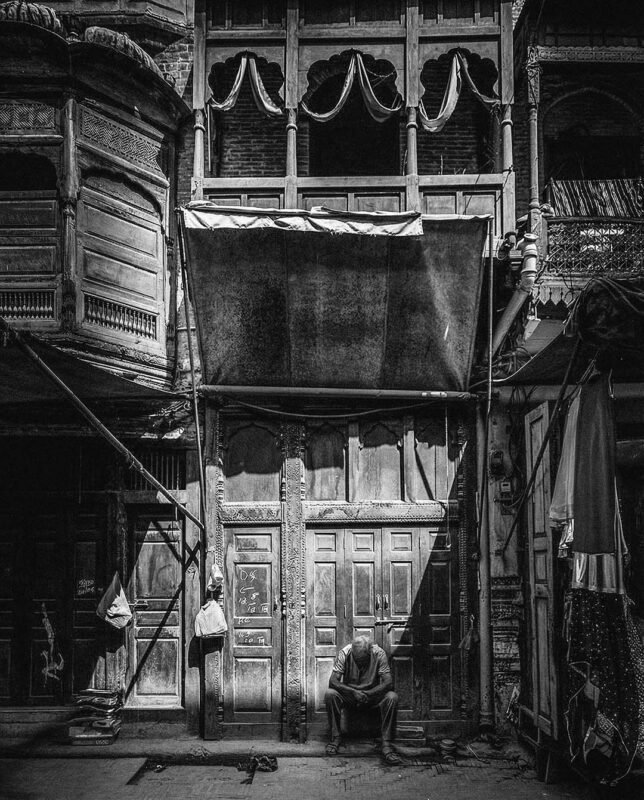
Chiselled by Light
So why is it that wedding photographs on social media feel wrong to me, while my own street work feels acceptable?
Maybe I have quietly drawn a line without thinking it through.
Part of me believes there is a difference between a private event and a public street. A wedding, even with hundreds of guests, still feels like a circle of trust. A bazaar does not. When you step into a busy road or market, you expect noise, dust, strangers, phones, security cameras and the possibility of being part of the background of someone’s photograph.
Another part of me tells me that this explanation is a little too convenient.
After all, a person in a street photograph also has a life, a story, a family. They may not be comfortable being recognised online. They may not want to become an example of anything. And yet I continue to make and share images, because for me this is how I make sense of the city I live in.
I do try to place my own limits. I avoid photographs that humiliate. I stay away from moments of obvious distress. I am careful with children. If someone notices the camera and clearly does not want to be photographed, I lower it. If anyone ever asked me to remove their image, I would delete it right there and then.
But none of this completely settles the question. It just makes it easier for me to keep working without feeling like I am crossing my own boundaries.
This note is not a set of rules for anyone else. It is not a guide to what is right or wrong. It is simply me saying out loud that if I feel uneasy about wedding photographers turning private events into content, then I also need to keep examining the way I use the lives of strangers in my own photographs.
Honestly, I do not have an answer for any of this yet. It just makes me a little uneasy these days. Maybe the best I can do is to keep that discomfort alive, to keep asking myself whether I am being fair to the people in my frames, and to remember that behind every photograph, whether taken in a marriage hall or in the streets of Lahore, there is a real human being who did not wake up in the morning thinking about my portfolio.