Whenever I visited Nisbat Road, I found myself slowing down in front of this building. I did not know who owned it or what stories lived inside. I only knew that something about its yellow walls, brickwork and tired doors kept pulling me back.
One day, I finally stopped and made a photograph. At the time it felt like any other frame from the city. I had no idea what was coming.
Weeks later, I passed by again and saw dust, noise and a half broken structure. The building was being demolished. I did not have a camera with me that day, so I walked on with only the memory of what I had seen.
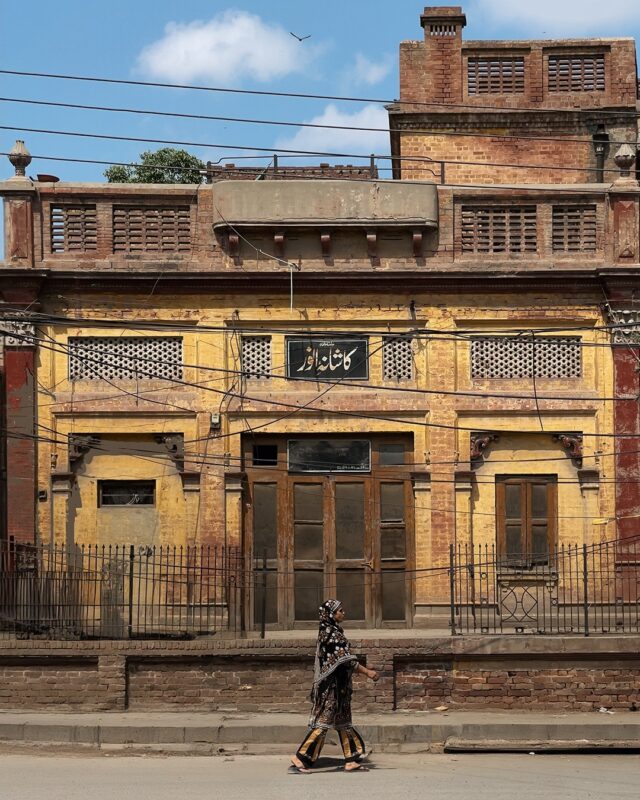
Back at home, I dug out the photograph I had taken earlier and shared it on Instagram with a short caption about how it was already gone by the time I posted it.
Under that photograph, someone left a comment:
“My Nana’s house… our childhood memories 😢❤️”
That simple comment carried a lot of weight. I had treated the building as a subject. For someone else it was a chapter of their life, a home filled with memories.
If you look at the photograph again, there is a small plaque above the doorway that reads “Kashanai Anwar” (کاشانۂ انور). In Urdu, it can mean Anwar’s house, or, read another way, a luminous dwelling. When I took the photograph, it was just another name on an old wall. After reading that comment, those words feel different now.
When photographs become the last witnesses
Lahore is full of buildings like this. Some are demolished overnight. Others are stripped and rebuilt with new fronts, tiles and glass until they are impossible to recognise. A few are restored with care, but many are simply cleared away for whatever comes next.
In this constant cycle, the photograph often becomes the last quiet record. The signboard, the balcony, the pattern of wires, even the way the plaster has peeled off the wall. Once the structure goes, these small details usually go with it.
We talk a lot about heritage in terms of famous sites and monuments. Yet the streets that form our everyday memory are made of ordinary clinics, shop fronts, family houses and corner buildings that never receive a heritage plaque. When they disappear, it is usually the personal memories that go first. The city moves on, but someone’s childhood is now only visible in an old album or in a picture a stranger happened to take.
While we may feel threatened by the onslaught of AI imagery, we cannot ignore the value of photographs that captured real moments, in real light, in real streets.
That is where the importance of photography lies. It captures a small slice of history, a memory, a record of how a place once felt. We may not know the people connected to a building, but we can still record how it looked before it is altered beyond recognition. Sometimes the photograph is all that remains.
Development, progress and what is lost in between
None of this is to say that the city should never change. Governments have to widen roads, build bridges and make room for new services. In a developing country there is constant pressure to favour projects that bring quick financial returns.
The problem is not change itself. It is how easily memory is treated as something with no value on a balance sheet. A row of old houses may stand in the way of a new road, but often there is little effort to document what is about to be removed. With more sympathetic planning, some facades could be saved, streetscapes could be adjusted and stories could be preserved rather than erased overnight.
Even when that does not happen, there is still room for individual effort. A photograph made from the opposite footpath costs almost nothing, yet it can hold a fragment of the city that the next generation will never see with their own eyes.
This is also why I keep returning to places like Amrat Dhara building and the other facades in my series. Some will survive, others will not. I cannot control which ones stay, but I can at least pay attention while they are still here.
Documenting the disappearing Lahore is not about nostalgia for its own sake. It is about recognising that streets, like people, do not last forever. If we do not look closely now, we may wake up one day in a city that feels strangely unfamiliar, with very few traces of what it used to be.
A camera and a little time on the street are small things, but sometimes they are all it takes to keep a piece of that story alive.
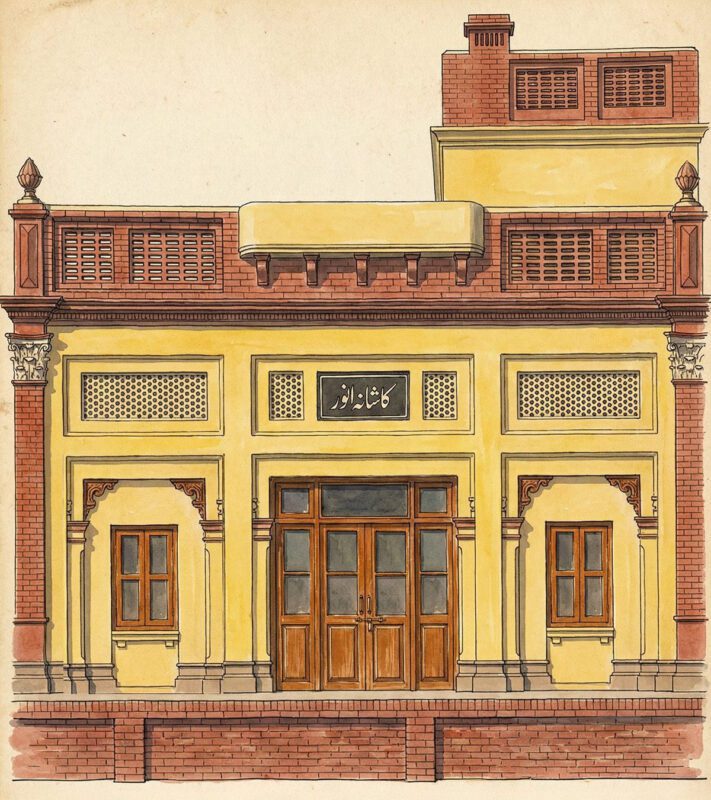
Illustration of a building that now lives only in the memories of those who once called it home.
Read my thoughts on: “Not Just Living for the Weekend”.