Some of my memorable conversations with strangers on the streets of Lahore started because of a camera hanging from my neck.
Carrying a camera works both ways. Most days it brings kind people, small stories and easy chats about photography. Every now and then there is a sharp comment or a question that makes you want to move on quickly. Either way, the camera has a way of pulling people towards you, whether you want it or not. Strangers in the street often notice what is hanging from your neck before they notice what is in the frame. A smaller or retro camera can make you invisible at times. The larger ones make you stand out.
I recently spent time shooting with the Nikon Zf on a street in Lahore. A stranger approached me to ask if it was a film camera. That simple question unlocked a long conversation about how he used to photograph the streets years ago. A retro camera like the Zf or a Fuji often signals hobby or even art. It reminds people of their grandfathers or their own past cameras. It sometimes turns the camera from a barrier into a bridge. The Zf pulled an old memory out of him and made me wonder why I did not buy it sooner. Most of the time, when I carry a larger camera in Lahore, people assume I am press. They ask which channel I am from or where the photo will be published. With the Nikon Zf, and even with Fuji bodies I had, that did not happen as much.
I have since sold the Nikon Zf. As much as I liked it, I am trying to simplify my camera gear for street photography in Lahore. The Nikon Z6iii has features I need and is easier to live with day to day, even if it looks like any other modern camera. I do miss the Zf, but it was a choice that had to be made.
-
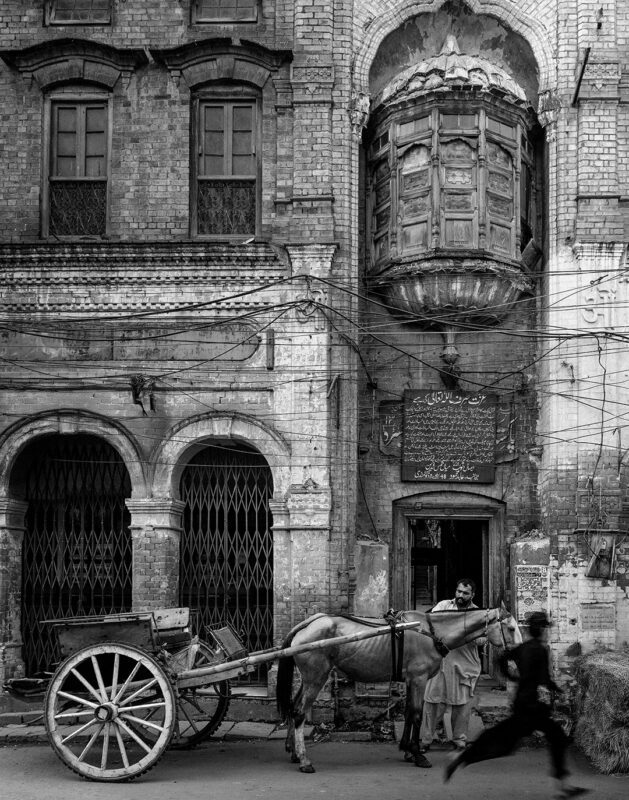
Amrat Dhara Building, Lahore
When I was photographing the Amrat Dhara building in Lahore and was about to leave, a shopkeeper from a nearby shop called me over. He offered to show me the interior so that I could record it before it is altered or replaced with something entirely new. He did not ask why I was photographing. It seemed he already knew. If I had been taking the same images with a mobile phone, I doubt he would have even bothered. A phone feels casual. A ‘proper’ camera tells people you are there for a reason. Sometimes they can feel threatened by it, but in this case he was happy that someone was documenting the building.
At my son’s school function some years ago, I had brought a Nikon D810 with me. A man walked up, smiled, and asked how much I had paid for it. He had bought his from the United States recently but paid more than I had. We spent most of the function talking about cameras, lenses and what we like to photograph. Similarly At my office, I once met the team leader of an engineering project we were working on, a consultant from the UK. We had the usual professional conversation until he noticed the camera that I had in my room. Everything shifted after that. It turned out he was a passionate photographer and one of the reasons he had taken the job in Pakistan was the chance to travel and photograph the northern areas. From that point on, our meetings usually had a few minutes of camera talk attached to them.
The camera does not just change how I see Lahore. It also changes how Lahore sees me.