My first real encounter with a TED Talk was in 2006, when I watched Ken Robinson speak about schools killing creativity. I had never been that impressed by a talk before. It stayed with me for years, somewhere in the background.
When I later started thinking about launching this website around photography, I made a small list of things I wanted to write about. Ken Robinson’s talk quietly slipped into that list. And then I realised I had never really followed up. I had not read his books or watched any more of his talks. Not until today.
So today I went back to YouTube and watched another one of his talks, “Bring on the learning revolution.” It moved me as much as the first. He talked about people who have no real sense of their talents, stuck in careers they do not enjoy, simply enduring their work days and waiting for the weekend. It sounds dramatic, but sadly it also feels uncomfortably familiar.
Enduring work, waiting for weekends
One of the things he describes is meeting people who do not hate their work, but do not feel alive in it either. They watch the clock. They come alive on Friday evening and slowly shut down again on Sunday night.
He contrasts that with people who feel the opposite. Time stretches when they do the work they love. They may still be tired at the end of the day, but it is a different kind of tired. It comes with a quiet satisfaction.
Some of us may have tasted both states. I know I have. There is the weekday version of life, the one full of emails, meetings and practical worries. And then there are those moments when I am walking on the streets of Lahore with a camera, or sitting with a single photograph trying to find the right words for it. The attention feels different. The noise drops a little.
Lives that are not straight lines
Ken Robinson keeps returning to the idea that real lives are not linear. We pretend they are: school, university, job, promotion, retirement. A clean line that moves upward if all goes well.
But when people tell their own stories honestly, they rarely sound like that. They move sideways. They start in one field and end up in another. They discover something late in life that quietly rearranges everything that came before.
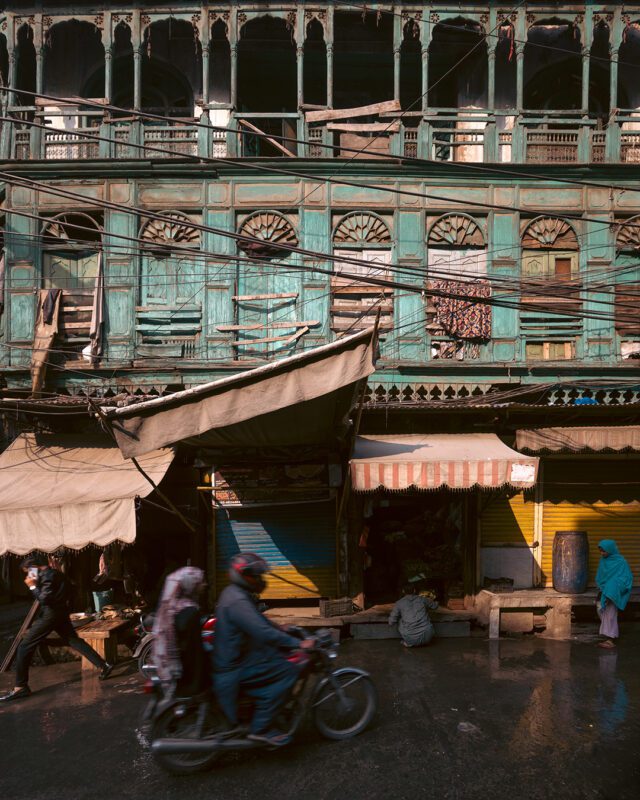
A winter morning inside Bhaati Gate — the part of the week that keeps me awake in a good way.
In my case, I studied engineering and computing and built a sort of career there. Whether I was ever really happy in that part of my life is another matter. Photography came in from the side. It was never part of a formal plan. It started as a distraction and slowly became something I keep making space for, even when the rest of life feels crowded. I consciously never tried to make money from it because that might have ruined the escape I had found from my work life. Listening to Ken Robinson again makes me feel less worried about how my life has unfolded.
Finding that small intersection
Outside the TED stage he often spoke about “the element” or the place where what you are naturally good at meets what you love to do. A lot of our unease, he suggested, comes from ignoring that small intersection for too long.
I do not know if I am fully in that place, but I recognise the feeling. There is a different kind of focus when I am on the street looking for light, or when I am writing these notes. The world does not disappear, but it softens around the edges.
This website is a small attempt to honour that intersection. To say: this part of my life matters too. The walking, the looking, the photographing, the sitting down later to think about why an image or a talk left a mark.
This note is a small thank you to him and a reminder to myself: pay attention to the work that keeps you awake in a good way, not just the work that gets you to the weekend.
Towards the end of the talk he quotes Yeats, about children spreading their dreams at our feet and the need to tread softly. He applies it to education, but I cannot help extending it to adults as well – the quiet dreams people set aside because they were told they were not practical.
Ken Robinson sadly passed away in 2020, but his talks and books are still out there, nudging people to pay attention to their own talents and to those around them. Watching him again after all these years felt like a reminder I needed.
About Sir Ken Robinson
Sir Ken Robinson (1950–2020) was a British author, speaker and advisor on education, known for his work on creativity, talent and learning. His TED Talk “Do schools kill creativity?” remains one of the most watched talks in TED’s history, and his books — including The Element and Creative Schools — continue to influence teachers, parents and policymakers around the world. More about his life and work can be found on his official website: https://www.sirkenrobinson.com
Read my thoughts on: Documenting the disappearing Lahore.