Most evenings, after work and family and everything else, I still find myself opening my website with a blank page to write. It feels slightly out of step with what the internet has become. People are on YouTube, TikTok and Reels. Attention is short. There is always a quiet doubt in the background: if so much can be watched, and so much can be written by AI, why bother adding more words?
Anyone who chooses to read in this environment is already swimming against the current. You have to pause the scroll and stay with a line of thought for more than a few seconds. The same doubt that sits with the writer often sits with the reader as well: is this worth my time? and is there a person behind these words or just a software arranging sentences with a mind of its own?
For photography it is not very different. There was a time when a strong image could stop you. Now we see hundreds every day, many of which are technically and creatively perfect. When there is so much to look at, even great work becomes easy to swipe past. Most of my photographs may not stand out at first glance, or if at all. They only begin to mean something when you know why I stopped there and not three steps earlier.
-
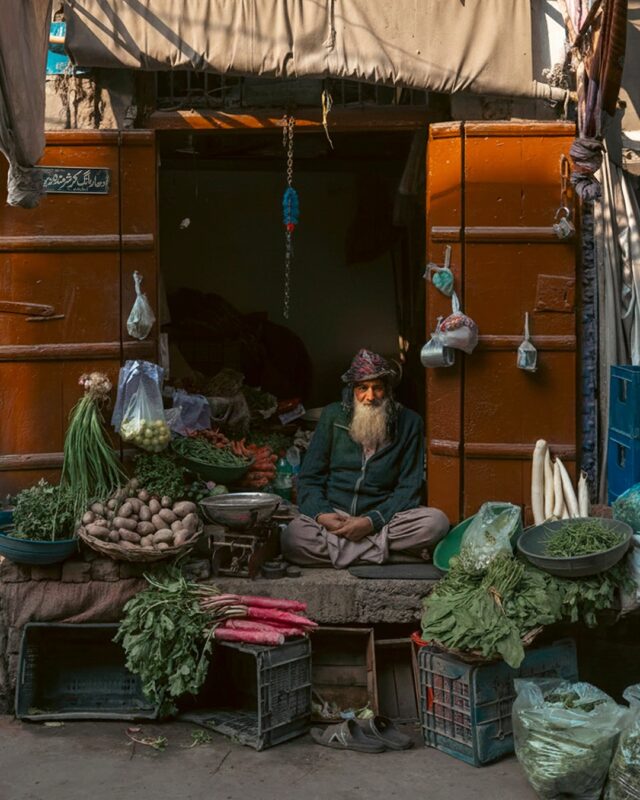
Early Morning, Bhaati Gate
That is where a bit of writing can help. A photograph holds the outside of a moment. A few lines of text, a note on that photograph, can quietly open the inside. The vegetable seller inside Bhaati Gate is not just about colour and light. He is part of a chain of mornings, of routes walked many times, of small conversations and worries and tiny joys. When images and words live together, they give a context that could easily be missed. The picture keeps the words grounded. The words give the picture a chance to be seen properly.
Writing also changes how a person observes or consumes information. Knowing that you will later have to explain a scene makes you pay attention to what it felt like, what the sign on the wall said, what was going through your mind when you lifted the camera and when you lowered it again. The page becomes a place to sort all of that out. Even if nobody else reads it, the act of writing turns vague reactions into clearer thoughts.
Then there is the AI question. More and more text online is shaped by such tools. It is natural to wonder if something has been written by a person or not. Many of us now do use AI for grammar checks, for research, for nudging a sentence in a cleaner direction and for its excellent research capabilities. But the tools do not decide what matters (at least for now). They do not choose the city you walk in, the streets you return to, the people you keep thinking about. They do not carry the small memories of your first camera, or the awkward moment when someone asked why you were taking photos there. That part is still human. The more specific and honest the writing is, the harder it is to fake.
So the point of all this is not to compete with video or to prove purity against machines or to claim that writing is superior to videos. It is simply to say that in all those clips and captions and polished language, perhaps there is still room for slow, ordinary pieces of writing that sit next to ordinary looking photographs and quietly explain why they mattered to someone.
If abundance makes both text and images feel lighter, pairing the two can sometimes give a bit of their weight back.