If you spend any time on YouTube, you will notice a pattern. The street photography lens is usually 35mm. Sometimes 28mm. The proper portrait lens is 85mm. A 24 to 70 zoom is all you will ever need. It sounds neat and reassuring. One focal length. One way of seeing. One formula.
When I hear people talk about 85mm as the classic proper portrait focal length, I think of Platon’s portrait of President Obama in the Smithsonian. It is a tight head and shoulders frame, his face filling most of it, but one cant ignore the fact that it was taken with a wide angle lens, probably a 24mm field of view instead of the safe 85mm we are told to use. That slight stretch in the features and the sense that the camera is right there in his space is a big part of why it works.
For a long time I tried to believe that 35mm was supposed to be the sweet spot. The internet said so, and the internet is rarely quiet. Many of the photographers I like are also associated with that focal length, so it was easy to think that if I just stayed at 35mm long enough, my photographs would suddenly start to feel more serious or classic.
The problem is that 35mm never felt like home.
It is not that 35mm is bad. It is a great focal length for many people. It lets you get close without too much distortion, it shows enough of the environment, and it is flexible for general use. The issue is different. The issue is the idea that there has to be a perfect focal length for everyone and that a beginner must pick one and stay there.
You also often hear that many master photographers used one focal length for most of their work, and that is true. Part of the reason was very practical. By removing one variable, they had one less decision to make in the moment. Their camera became an extension of their body and they knew exactly what the frame would look like before bringing it to their eye. That simplicity is powerful.
But we rarely see how long it took them to get there. They did not wake up one day, buy a 35mm lens because a stranger on the internet told them to, and then stick to it forever. They arrived at that focal length after years of trial and error, after seeing what worked for their way of looking at the world. Their focal length is the result of their experience, their cities, their stories, their time. It does not automatically translate to yours.
This is where YouTube complicates things. Most photography channels today are run by people who are content creators first and photographers second. That is not meant as an insult, it is simply how the internet works. They have to publish regularly, keep things simple, avoid pushing too hard against what already works, and make sure the videos are easy to digest.
Telling a beginner, just use 35mm and forget everything else, makes for a very tidy video. It sounds confident. It can be supported with a few quotes from famous photographers, which gives the impression that some deep research has been done. What we do not see is how much quiet experimentation with focal lengths has happened off camera, without a thumbnail and title to go with it.
Focal length is not just a number written on the lens. It decides how close you need to stand to someone. It decides how much of the chaos of a street corner enters your frame and how much you can leave out. It changes how compressed or stretched a scene feels, and whether you feel like a participant in the moment or a slightly distant observer.
-
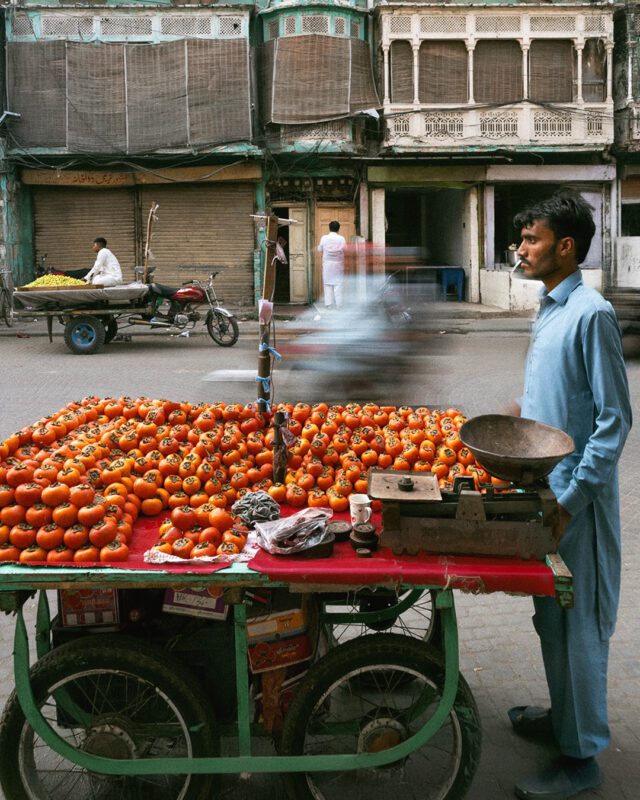
Three men, three separate worlds
In a city like Lahore, this matters. Sometimes the street is too busy and you simply cannot stand as close as a 35mm lens demands without blocking the way or becoming part of the scene in a way that does not feel honest. Sometimes you want to isolate a small gesture in the middle of a very messy background, and you need a longer focal length to do that without turning the photograph into a cluttered puzzle. At other times, you want the opposite. You want the whole chaos, the layers of people, wires, signs and fading paint, and a wider focal length serves the story better. A single sweet spot cannot do all of that well.
I see this playing out in a very specific way, here in Lahore. Our camera market is dominated by wedding photographers. That is where most people with cameras actually make their living. Fashion photography is another world altogether. It sits with a small number of already successful photographers and is now under pressure from AI tools, but they are not the ones looking for lens advice on YouTube. Wedding work is different. It is here to stay for a while and in the past few years I have seen almost every wedding photographer settle on the same kit a 35mm f/1.4 and, if there is some money left, a 70 to 200 zoom. The classic 85mm has quietly lost ground. Part of it is simple economics. With inflation the way it is, most photographers do not have the luxury of buying lenses just to experiment. They look at what a successful wedding photographer is using, watch a few YouTube videos that praise that focal length as perfect for weddings, and then feel they must build their entire way of seeing around that choice. I genuinely feel sorry for the wedding photographer with very limited means who bought into that hype and, without even realising it, denied himself the chance to experiment.
There is also a practical side to this debate that often gets lost. Primes are usually smaller and lighter than zooms. They are simple, they let in more light, and they can encourage a certain discipline. I understand why a working photographer who already knows how they like to shoot will reduce the choices and stick to one or two primes. It makes sense when your style is already formed.
But for someone just starting out, the opposite may be true. A good zoom might actually be the better teacher. It gives you the chance to feel what 24mm does to a scene compared to 35mm or 50mm, without forcing you to buy three separate lenses first. As long as you do not use the zoom as a lazy way to avoid moving your feet, it can be a useful way to explore focal lengths and notice what feels natural.
Over time, you may find that most of your favourite images sit around one particular focal length. At that point, buying a prime in that range makes sense. You are not copying a number from a YouTube video, you are honouring what your own photographs have quietly been telling you. In my case however, I went the opposite route. I started off with primes and settled on zooms because that is how it worked out for me.
When new photographers hear the same advice repeated again and again, they may never reach that stage. They buy a 35mm lens because someone they follow says it is the only lens they need, then feel quietly guilty when the images do not match the romantic idea they were sold. Beginners might not even have the luxury to buy another lens when the first did not work out for them.
Conseuquently what they miss is the simple permission to experiment.
You learn a lot by making a mess. By putting a 50mm on the camera for a month and seeing how it changes the way you walk. By going out with a longer lens for a while and noticing how your distance from people alters the mood. By discovering that sometimes a slightly awkward focal length is what gives your work its character, even if it is not popular in video titles.
I am not arguing against 35mm, or against the people who love it. I am only saying that it is fine if it does not work for you. It is fine if your way of seeing needs a different distance, a different compression, a different relationship with the scene in front of you.
If you are just starting out, my suggestion is simple. Be careful when someone tells you that there is one magic focal length, especially when it comes packaged as an easy shortcut to better photographs. Try different focal lengths instead. Live with them for a while. Use a zoom if that makes it easier to explore. Pay attention to which settings help you say what you want to say, not what the algorithm would like you to repeat.
Your style will not come from copying someone else’s favourite number on the lens. It will come from the quiet, slightly uncomfortable process of finding out what feels honest when you raise the camera to your eye.